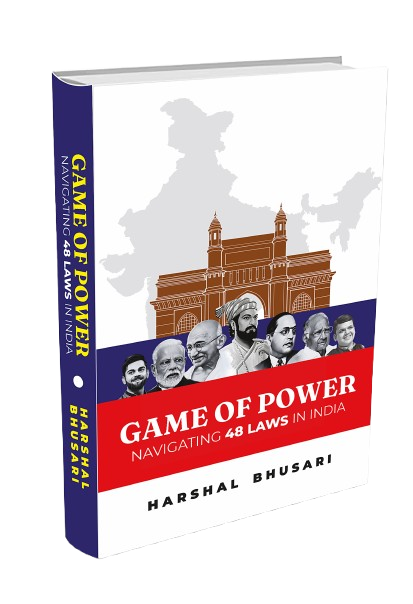
About Game Of Power
The 48 Laws of Power by Robert Greene is widely regarded as a seminal work on power dynamics, drawing inspiration from timeless sources such as Kautilya’s Arthashastra, Machiavelli’s The Prince, and Sun Tzu’s Art of War. Despite its acclaim, the book notably lacks a distinct Indian context. India, as the world’s longest-surviving civilization, has witnessed countless dynasties—from the Mauryas to the Marathas—each engaging in experiments to capture, retain, expand, and consolidate power. Yet, Greene’s influential work remains devoid of examples rooted in this vast and ancient landscape of Indian power struggles.
This gap has inspired the creation of a new work titled Game of Power: Navigating 48 Laws in India, which not only contextualizes Greene’s laws within the Indian historical framework but also reinterprets them through the lens of India’s rich history, mythology, and modern political dynamics. This book revisits each of Greene’s 48 laws, exploring their relevance to Indian history, from ancient texts like the Mahabharata and Vishnu Purana to the actions of modern political figures such as Nitin Gadkari, Amit Shah, Narendra Modi, Sharad Pawar, Sonia Gandhi, Arvind Kejriwal, Uddhav Thackeray, and Devendra Fadnavis.
Through a deep dive into India’s historical and mythological narratives, the book showcases how Indian rulers and strategists have applied principles of power across millennia. From Chandragupta Maurya’s strategic alliance with Chanakya to Harshavardhan’s empire-building, and from medieval invasions led by Mohammad Ghori to the pivotal Battle of Plassey, the narrative highlights how India’s influential figures mastered the dynamics of power. Additionally, examples like Shivaji Maharaj’s innovative strategies in establishing the Maratha empire provide readers with practical lessons in leadership and strategy relevant to contemporary times.
Game of Power: Navigating 48 Laws in India draws from an extensive range of sources to support this reinterpretation. These include historical and literary works such as Ranjit Desai’s Shriman Yogi and Nagnath Inamdar’s Rau, along with foundational texts like the NCERT history books, From Plassey to Partition, India’s Struggle for Independence, and India After Gandhi. Classic treatises like the Arthashastra, The Prince, and The Art of War also serve as significant reference points.
Far from being a mere adaptation, Game of Power: Navigating 48 Laws in India offers a comprehensive reimagination of how power has been wielded, challenged, and sustained throughout India’s history. Each law is rewritten with four to five relevant Indian examples, making the book a compelling guide for leaders, thinkers, and individuals keen on understanding power dynamics in an Indian context. By blending detailed analysis with rich storytelling, the book provides practical lessons for navigating modern political and business landscapes, all while celebrating India’s unparalleled legacy of power politics.
GAME OF POWER
Navigating 48 Laws in India
Ebook is available on Amazon.